

2514 Hollywood Blvd STE 408
Hollywood, FL 33020
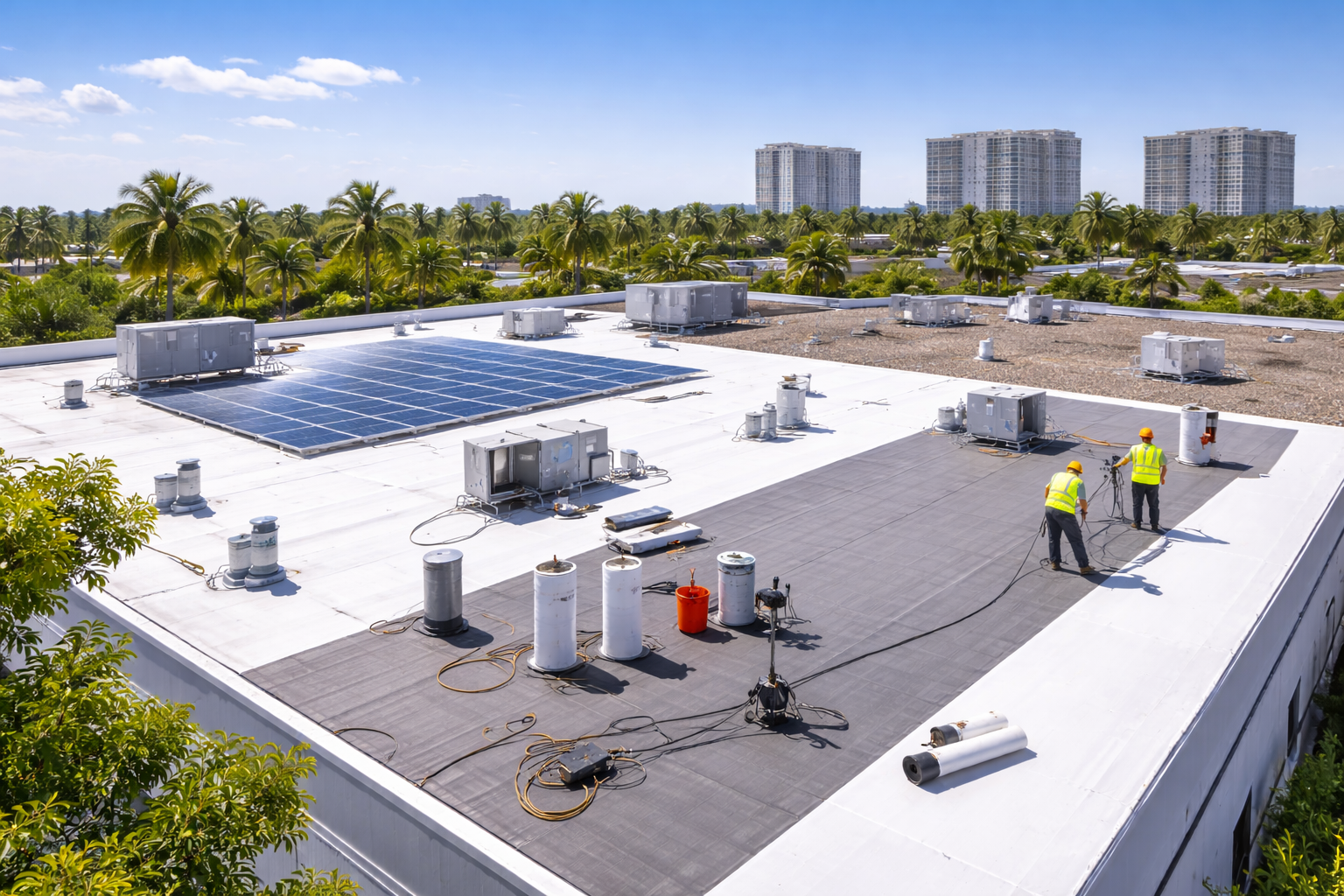
In Miramar, commercial roofs are tested year-round. Intense heat, daily humidity, sudden downpours, and long rainy stretches all place constant pressure on roofing systems. The result is simple but costly: not every roofing system performs well here, even if it performs fine in other regions.
That is why choosing the right system for commercial roofing in Miramar, FL is not about trends or lowest upfront cost. It is about how materials behave under heat expansion, moisture exposure, drainage stress, and long-term weather cycles that define South Florida.
Understanding which systems hold up best, and why, helps owners avoid premature failures, repeat leaks, and replacement decisions that come far sooner than expected.
Miramar’s roofing challenges are not seasonal. They are constant.
High temperatures cause roofing materials to expand during the day and contract at night. Over time, this movement stresses seams, fasteners, and transitions. Add heavy rain that tests drainage performance and wind-driven moisture that finds weak points, and roofs are under daily pressure even when there is no storm.
Flat and low-slope roofs dominate commercial properties here, which means water does not run off quickly. If drainage slows or details fail, moisture stays in contact with the system longer, accelerating wear.
This environment makes material selection and installation details more important than marketing claims.
Performance in Miramar is not just about durability. It is about consistency.
The systems that perform best here share a few critical traits:
●
They tolerate constant heat cycling without seam failure
●
They resist prolonged moisture exposure without degrading
●
They integrate well with drainage systems
●
They allow for reliable detailing around penetrations and edges
●
They can be serviced and maintained without creating new weaknesses
These factors matter more than appearance or brand name.
TPO is widely used across South Florida for good reason. It reflects heat well, performs efficiently in high temperatures, and works effectively on large flat commercial roofs when properly installed.
In Miramar’s heat, reflective membranes help reduce surface temperatures and slow thermal stress on the system. However, TPO performance depends heavily on seam quality, attachment method, and flashing details.
Poor welds or rushed detailing often lead to early seam failures, which is why installation quality matters as much as material selection. When done correctly, TPO remains one of the most reliable flat roofing options for commercial properties here.
Modified bitumen continues to be a strong performer in South Florida because of its layered construction and flexibility.
In the ongoing debate of TPO vs modified bitumen, modified systems often perform better in areas with complex detailing, penetrations, and transitions. Their multi-ply construction provides redundancy, which helps prevent sudden failures when one layer is compromised.
Modified bitumen also handles foot traffic and rooftop equipment areas well, making it a good choice for buildings with frequent roof access. While it may not offer the same reflectivity as TPO without coatings, its durability in wet conditions is a major advantage.
Liquid-applied roofing systems can perform well in Miramar when used for the right applications.
They are especially effective for restoring aging roofs that are still structurally sound but experiencing surface degradation or recurring seam issues. Liquid systems create a seamless membrane, which reduces the number of failure points.
However, surface preparation is critical. Moisture trapped below the system or improper curing conditions can compromise performance. These systems work best when installed as part of a planned restoration strategy, not as a quick fix.
Metal roofing offers long lifespan potential, but it behaves differently under South Florida conditions.
Heat expansion is significant with metal systems. Without proper detailing, expansion and contraction can loosen fasteners and create gaps over time. Metal also relies heavily on correct flashing and fastening methods to stay watertight during wind-driven rain.
Metal systems can perform well on certain commercial buildings, but they require careful evaluation of structure, slope, and exposure before being selected as the right solution.
Most commercial properties in Miramar rely on flat or low-slope roofing by design. That makes drainage performance one of the most important system considerations.
The best flat roofing options are those that work with drainage, not against it. Systems that allow water to move efficiently toward drains, tolerate brief ponding without degradation, and resist seam stress outperform systems that rely on ideal conditions.
Drainage design, slope correction, and detail integrity often matter more than the membrane itself.
Even the best materials fail when installed poorly.
Many roofing problems blamed on materials are actually caused by:
●
Incompatible repair materials
●
Poor seam welding or adhesion
●
Weak flashing around penetrations
●
Improper edge terminations
●
Ignored drainage deficiencies
In Miramar, systems fail early when shortcuts are taken. Long-term performance comes from matching the right system to the building and installing it to handle real conditions, not ideal ones.
There is no universal answer for the best system. The right choice depends on:
●
Building size and use
●
Roof slope and drainage layout
●
Amount of rooftop equipment
●
Exposure to wind and water
●
Maintenance expectations
What performs best on a warehouse may not perform best on an office building or retail center. That is why system selection should be based on inspection and performance needs, not assumptions.
The most expensive roofing mistakes usually happen before installation begins. Choosing a system without understanding how it will behave in Miramar’s heat and rain leads to early repairs, recurring leaks, and shortened lifespan.
When systems are selected and installed with climate, structure, and drainage in mind, roofs last longer, cost less to maintain, and disrupt business far less.
Miramar roofs fail when systems are chosen for convenience instead of climate. If you want a commercial roofing system that holds up under heat, rain, and daily exposure, C.A.R.E. Construction can evaluate your building and recommend a system that fits real conditions, not generic expectations.
What commercial roofing system performs best in Miramar, FL’s heat?
Systems that tolerate heat expansion and reflect solar load, such as properly installed TPO or coated systems, generally perform well when drainage and detailing are handled correctly.
Is TPO better than modified bitumen in Miramar, FL?
Neither is universally better. TPO performs well for heat reflectivity, while modified bitumen excels in durability and complex detailing. The best choice depends on building conditions.
Why do flat roofs fail faster in South Florida?
Flat roofs rely heavily on drainage and seam integrity. Heat, moisture, and slow water runoff accelerate wear if maintenance and detailing are neglected.
Can liquid-applied roofing systems work in Miramar, FL?
Yes, when used appropriately. They work best for restoration projects where the underlying roof is sound and properly prepared before application.
Does metal roofing perform well in Miramar, FL?
Metal can perform well on certain buildings but requires careful detailing to manage heat expansion and wind-driven rain.
How important is drainage to roofing system performance?
Extremely important. Poor drainage accelerates membrane wear, increases leak risk, and shortens roof lifespan regardless of material.
What causes most early commercial roof failures?
Installation shortcuts, weak flashing details, incompatible repairs, and ignored drainage problems are the most common causes.
Can the right roofing system reduce long-term maintenance costs?
Yes. Systems chosen for climate and building use require fewer emergency repairs and last longer when maintained properly.
How often should commercial roofs be evaluated in Miramar?
At least twice per year and after major storms to monitor heat-related wear, drainage performance, and seam condition.
What is the first step in choosing the right roofing system?
A documented roof inspection that evaluates structure, drainage, exposure, and existing conditions before recommending repair, restoration, or replacement.
CGC1537535 | CCC1335982 | CMC1251555
At C.A.R.E. Construction, we uphold industry standards by using top-quality materials, cutting-edge tools, and delivering exceptional service to our clients.

2514 Hollywood Blvd STE 408
Hollywood, FL 33020

Broward:
Miami:
Tampa:
