

2514 Hollywood Blvd STE 408
Hollywood, FL 33020
Most commercial roofs do not fail loudly. They fail quietly, in ways that slowly drain money long before a bucket ever shows up inside the building. By the time water is visible, the roof has often been costing the business far more than expected for months or even years.
This is a common pattern with commercial roofing in Hollywood, FL, where heat, humidity, storms, and flat roof designs combine to create issues that stay hidden until the cost multiplies. What looks like a minor nuisance is often a system-level problem quietly affecting energy bills, interiors, tenant satisfaction, and long-term roof lifespan.
Understanding where money is lost is the first step to stopping it.
Many owners assume a roof is only a problem when water comes inside. In reality, roofs begin losing money much earlier through inefficiency and deterioration that is easy to miss from the ground.
When seams weaken, insulation becomes damp, or membranes lose integrity, the roof stops performing as a protective barrier. That does not always create an immediate leak, but it does increase heat transfer, raise cooling costs, and shorten the roof’s usable life.
These losses are gradual, which is why they often go unnoticed. But over time, they add up to real operating expenses.
One of the most misleading signs is a leak that appears briefly, then disappears. Many owners assume the problem resolved itself. In reality, water may have entered during a storm, then dried enough to stop showing inside, while moisture remained trapped within the roof system.
That trapped moisture can spread laterally, weakening insulation and membranes over time. The next storm pushes water further, and suddenly the leak reappears somewhere else. This is how commercial roof leaks in Hollywood often behave, moving and returning instead of staying in one obvious spot.
Each cycle increases repair complexity and cost, especially if the true entry point was never identified.
Cooling costs in South Florida are already high. When a roof begins to fail, those costs climb quietly.
Wet or compressed insulation loses thermal resistance. Gaps at seams and penetrations allow heat to enter the building envelope. Reflective surfaces degrade, absorbing more heat instead of deflecting it. The HVAC system works harder to maintain indoor temperatures, and energy bills rise with no clear explanation.
This type of roofing energy loss is rarely linked back to the roof until a detailed inspection shows the connection. By then, the business may have been paying more every month without realizing why.
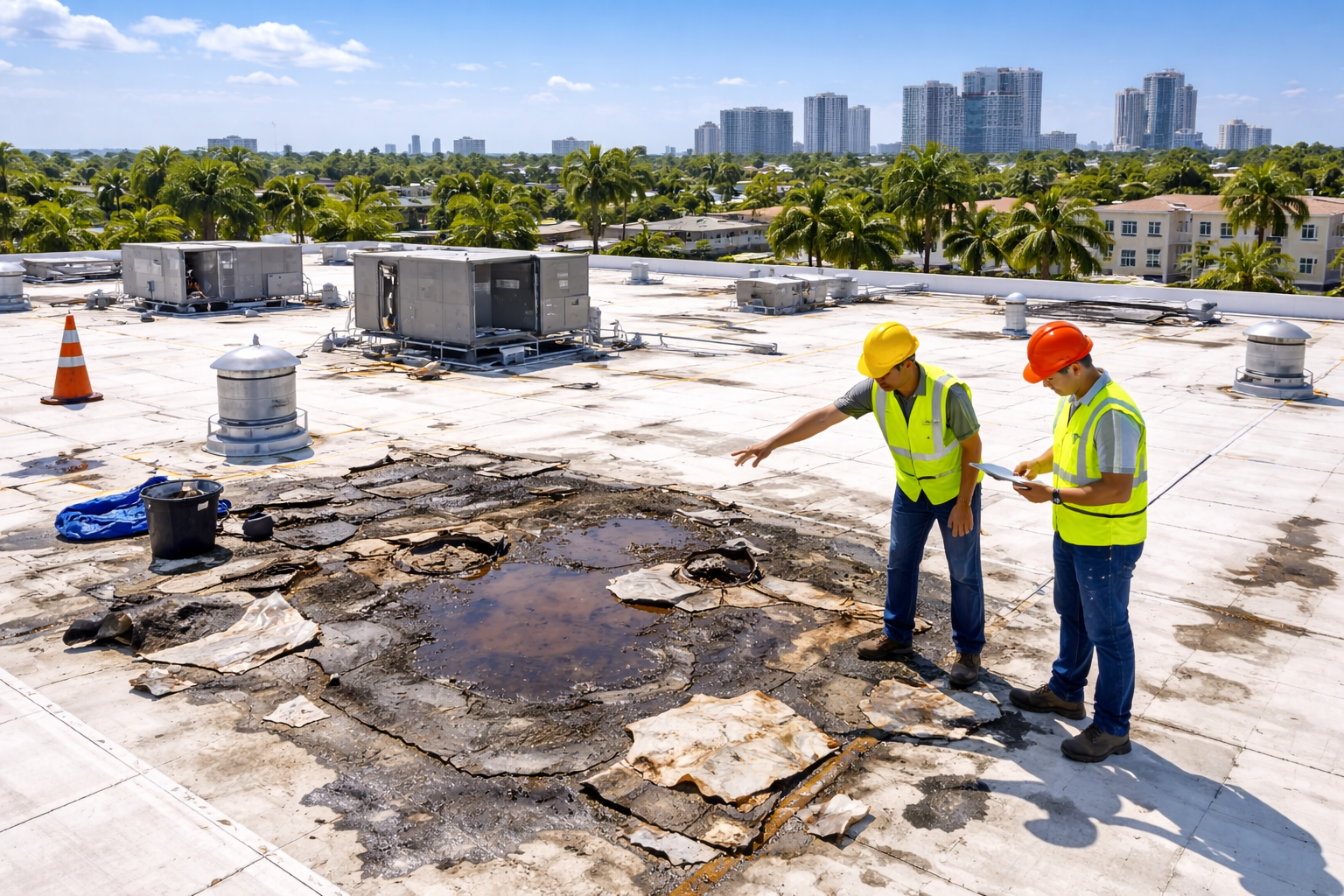
Flat and low-slope roofs behave differently than steep systems. Water does not run off quickly. It drains slowly, following subtle slope changes and pooling where drainage is compromised.
When water enters a flat roof system, it can travel under the surface before dropping into the building. That delay hides the entry point and spreads moisture wider than expected. Over time, insulation degrades, membranes fatigue, and repairs become less predictable.
These flat roof problems are common in commercial properties because they rely heavily on proper drainage and detail integrity. When those elements are ignored, the roof becomes a slow-moving expense rather than a sudden failure.
Clogged drains, blocked scuppers, and subtle slope changes do more than cause ponding water. They keep moisture in contact with the roof surface longer than intended.
Standing water increases heat stress, softens membranes, and pushes water into seams and transitions. It also hides early warning signs, making inspections harder if drainage is not addressed first.
Drainage issues are one of the most common reasons roofs fail earlier than expected, and they are also one of the easiest problems to prevent when addressed early.
Quick patches often feel like progress, especially when they stop an active leak. The problem is that many patches are applied where water shows up inside, not where it enters the roof system.
When repairs focus on symptoms, the roof continues deteriorating elsewhere. That leads to repeat service calls, interior disruption, and a growing sense that the roof is “unreliable,” even though the true issue was never corrected.
Over time, the building spends more on short-term fixes than it would have spent on targeted corrective work done earlier.
Once moisture enters a commercial roof system, it does not stay confined to the surface. It can affect insulation, decking, fasteners, and interior materials.
This creates secondary costs that owners often do not associate with roofing:
●
Ceiling tile replacement
●
Electrical issues
●
Mold mitigation
●
Interior finish repairs
●
Tenant complaints and lost productivity
These costs often exceed the original roofing repair, especially when moisture goes undetected for long periods.
In Hollywood, storms rarely create roof problems from scratch. They expose weaknesses that were already present.
Wind uplift stresses edges and penetrations. Heavy rain tests drainage and seams. Pressure changes push water into vulnerable transitions. If the roof has weak points, storms reveal them quickly.
This is why many “storm damage” claims are actually the result of long-standing deterioration finally reaching a breaking point.
The most expensive roofing decisions are made under pressure. When water is entering occupied spaces, approvals are rushed, options are limited, and work happens under emergency conditions.
Early action keeps decisions controlled. Inspections catch wear before moisture spreads. Repairs stay smaller. Maintenance extends system life. Replacement decisions can be planned instead of forced.
This is the difference between managing roofing costs and reacting to roofing failures.
The solution is not constant construction. It is clear.
Knowing where the roof stands, what is failing, and what needs attention now versus later prevents unnecessary spending and emergency disruption. It also protects energy efficiency and extends the life of the system.
A roof that is understood is cheaper to own than a roof that is ignored.
If your commercial building in Hollywood has rising energy bills, recurring leaks, or unexplained interior issues, the roof may already be costing more than you realize. Have C.A.R.E. Construction evaluates roof condition and identifies hidden failure points so problems are corrected early, before they turn into interior damage, emergency repairs, and avoidable expense.
Can a commercial roof lose money without leaking?
Yes. Energy loss, wet insulation, and degraded membranes can increase cooling costs and shorten roof life without visible interior leaks.
Why do commercial roof leaks seem to move around the building?
Water often enters at one point and travels under the roof system before appearing inside. That makes the leak show up far from the true entry point.
How does roofing affect energy bills in South Florida?
Damaged or wet insulation, failed seams, and degraded reflective surfaces allow more heat into the building, forcing HVAC systems to work harder.
Are flat roofs more expensive to maintain than other systems?
They are not necessarily more expensive, but they require consistent drainage management and inspection because water behaves differently on low-slope systems.
Is ponding water always a serious problem?
Yes. Standing water accelerates membrane wear, increases leak risk, and hides developing damage that becomes costly later.
How often should commercial roofs be inspected in Hollywood?
Most should be inspected at least twice per year and after major storms to catch early deterioration and drainage issues.
Can minor repairs prevent full roof replacement?
In many cases, yes. Early targeted repairs and maintenance can significantly extend roof lifespan when moisture has not spread widely.
What usually costs more: planned repairs or emergency roofing work?
Emergency work almost always costs more due to urgency, limited options, interior damage, and after-hours labor.
How do I know if moisture is trapped in my roof system?
Soft areas, recurring leaks, persistent odors, and unexplained interior humidity can all indicate trapped moisture that needs evaluation.
What is the first step to stopping hidden roofing costs?
A documented inspection that identifies failure points, drainage performance, and insulation condition, so decisions are based on facts instead of assumptions.
CGC1537535 | CCC1335982 | CMC1251555
At C.A.R.E. Construction, we uphold industry standards by using top-quality materials, cutting-edge tools, and delivering exceptional service to our clients.

2514 Hollywood Blvd STE 408
Hollywood, FL 33020

Broward:
Miami:
Tampa:
