

2514 Hollywood Blvd STE 408
Hollywood, FL 33020
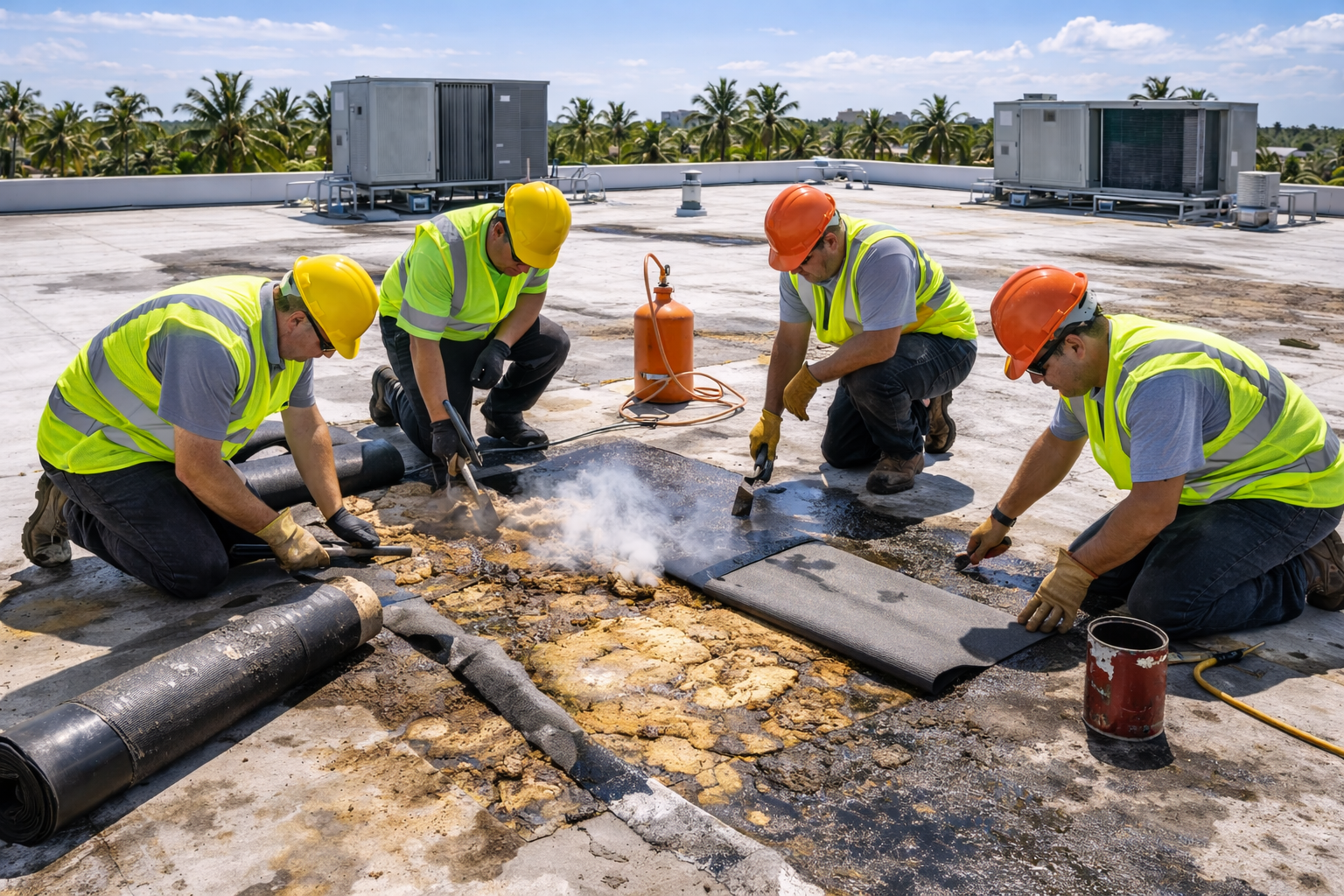
One of the most stressful decisions a commercial property owner can face is choosing between repairing a roof or replacing it entirely. In Pompano Beach, that decision is rarely straightforward. Heat, humidity, storms, and flat roof systems complicate the math, and making the wrong call can mean spending money now only to spend more later.
That is why understanding commercial roof repairs in Pompano Beach, FL requires more than looking at today’s invoice. It requires understanding how costs behave over time, what conditions signal diminishing returns, and when continuing to repair quietly becomes the most expensive option.
This guide breaks down how experienced owners and property managers weigh repairs versus replacement, without sales pressure or guesswork.
Pompano Beach roofs operate under constant stress. Heat drives expansion and contraction every day. Rain events test seams, flashing, and drainage repeatedly. Flat and low-slope systems hold water longer, which accelerates deterioration when small issues are ignored.
Because of these conditions, roofs here often reach a point where repairs still “work,” but only briefly. That gray area is where most owners overspend, approving repeated scopes without realizing the roof has crossed a performance threshold.
Understanding that threshold is the key to controlling cost.
Repairs are meant to restore performance when the system is still fundamentally sound.
Effective repairs address specific failure points such as seams, flashing, penetrations, drains, or localized membrane damage. When moisture has not spread widely and insulation remains dry, repairs can be extremely cost-effective.
In these cases, repair work stabilizes the roof, prevents leaks, and extends usable life without the disruption or cost of full replacement.
This is where repairs deliver real value.
Problems begin when repairs stop addressing isolated failures and start chasing symptoms.
A roof that needs frequent repairs across multiple areas is telling you something important. The membrane may be breaking down broadly. Seams may be failing in several zones. Moisture may already be trapped within the system.
At this stage, repairs still “fix leaks,” but they do not restore reliability. Costs rise because:
●
Repairs are repeated after every major storm
●
Water finds new paths instead of staying contained
●
Interior damage risk increases
●
Labor and access costs stack up
This is when owners often underestimate total spend. Individually, each repair seems manageable. Collectively, they exceed what a planned replacement would have cost.
Repair costs vary widely, but the biggest driver is not material. It is scope frequency.
A single, well-targeted repair is far less expensive than multiple reactive repairs spread across the year. Add emergency labor, after-hours work, interior protection, and tenant disruption, and the true cost grows quickly.
Roof repair cost in Pompano Beach is also influenced by access difficulty, roof complexity, and how much moisture has already entered the system.
Early repairs are cheaper because the roof is still cooperative. Late repairs fight against existing damage.
Replacement is not just about new material. It resets the system.
A full replacement addresses issues repairs cannot fix, including:
●
Saturated insulation
●
Widespread membrane deterioration
●
Incompatible past repairs
●
System design flaws affecting drainage
●
Aging materials that no longer perform reliably
Replacement eliminates recurring leak paths and restores predictability. That predictability is what many owners value most, even more than cost savings.
The decision is rarely about “cheapest now.” It is about total cost over time.
Repairs make sense when:
●
Failures are localized
●
The system is structurally sound
●
Moisture intrusion is limited
●
Repair intervals are long
Replacement makes sense when:
●
Leaks return despite proper repairs
●
Failures appear across multiple areas
●
Moisture is widespread
●
Repair frequency increases
In Pompano Beach, the tipping point often arrives sooner because environmental stress accelerates deterioration.
Delaying replacement once the roof is past its serviceable stage does not save money. It increases cost.
As moisture spreads, replacement scopes grow. More insulation must be removed. Interior protection becomes more complex. Scheduling becomes harder because work must avoid active leaks.
The most expensive replacements are the ones done after years of “just one more repair.”
The most common reason owners overspend is lack of clarity.
Without documentation, decisions are emotional. One leak feels manageable. Two leaks feel annoying. Five leaks feel urgent. But none of those feelings reflect actual roof condition.
A documented inspection clarifies:
●
Where water is entering
●
How far moisture has spread
●
Which areas are still stable
●
Whether repairs will meaningfully extend life
This information turns a stressful decision into a controlled one.
Repairs create variable costs. Replacement creates a predictable one.
Many property owners prefer to plan a replacement on their terms rather than budget indefinitely for emergency work. Predictability matters for multi-tenant buildings, HOAs, and portfolio managers.
Choosing the right path at the right time stabilizes budgets and reduces operational risk.
Replacing too early wastes value. Replacing too late increases cost and disruption.
The goal is not to replace at the first sign of trouble. It is to replace when repairs no longer protect the system as a whole.
That timing is different for every building, which is why blanket rules rarely work.
Owners who manage roofing costs well do three things consistently:
1.
They evaluate condition, not age
2.
They track repair frequency and performance
3.
They plan replacement before emergencies force it
This approach minimizes surprises and keeps decisions aligned with actual roof behavior.
If your commercial roof in Pompano Beach keeps demanding attention and costs feel unpredictable, the real question is whether repairs are still delivering value. C.A.R.E. Construction helps owners evaluate roof condition honestly, compare repair versus replacement costs clearly, and choose the option that prevents paying twice.
How do I know if my roof should be repaired or replaced?
If repairs are infrequent and effective, repair makes sense. If leaks keep returning across multiple areas, replacement should be evaluated.
Is roof age enough to decide on replacement?
No. Condition and moisture presence matter more than calendar age.
Why do repairs sometimes stop working?
Because the system has deteriorated beyond isolated failures, allowing water to enter in new locations.
Does replacement always cost more than repairs?
Not long-term. Repeated repairs often exceed the cost of a planned replacement.
Can inspections really change the decision?
Yes. Documentation shows whether repairs will extend life or simply delay replacement briefly.
What makes Pompano Beach roofs fail faster?
Heat cycling, heavy rain, flat roof drainage challenges, and humidity all accelerate wear.
Is it risky to wait until leaks are severe before replacing?
Yes. Waiting increases replacement scope, interior risk, and overall cost.
Can partial replacements work?
In some cases, but only when deterioration is limited to specific zones.
What is the biggest financial mistake owners make with roofing?
Approving repeated short-term repairs without reassessing overall roof condition.
Who should be involved in the repair vs replacement decision?
Property owners, managers, and a qualified commercial roofing contractor who provides documented findings, not assumptions.
CGC1537535 | CCC1335982 | CMC1251555
At C.A.R.E. Construction, we uphold industry standards by using top-quality materials, cutting-edge tools, and delivering exceptional service to our clients.

2514 Hollywood Blvd STE 408
Hollywood, FL 33020

Broward:
Miami:
Tampa:
