

2514 Hollywood Blvd STE 408
Hollywood, FL 33020
The easiest way to spot a building that is being managed well is not the lobby. It is the roof.
Not because the roof looks pretty. Most commercial roofs do not look like anything from the street. But when a roof is managed properly, the building stays dry, tenant complaints stay low, emergency calls stay rare, and budgets stop getting hijacked by “surprise” repairs that never feel small.
In Pembroke Pines, that outcome is not luck. It is a management pattern.
A commercial roof here deals with heat-driven movement, heavy rain, wind events, and humidity that keeps moisture active once it gets into a system. That is why commercial roofing in Pembroke Pines, FL is not something strong property managers leave to chance. They treat it like an asset that must be protected with rhythm, documentation, and decision-making discipline.
Below is what those managers actually do, and why it works.
The biggest shift happens in mindset.
Average properties treat roofing as “a cost we deal with when it leaks.” Strong properties treat roofing as “a protective system that keeps operations stable.” That difference changes everything, because it moves roofing decisions out of panic mode and into planning mode.
When the roof is seen as an asset, property managers ask better questions:
●
What is the roof’s current condition, not just its age?
●
Where are the predictable failure points for this system?
●
What is the roof costing us right now in downtime and interruptions?
●
What do we need to do this year to prevent a forced decision next year?
That is roofing asset management in real life. It is not a theory. It is the daily practice of reducing uncertainty before uncertainty becomes expensive.
A roof can look “fine” from the ground and still be failing in places that matter.
Good property managers do not run on vibes. They run on evidence. They insist on documentation that shows what is happening on the roof, where risks are forming, and what should be handled now versus monitored.
When this is done consistently, two things happen:
1.
Decisions get easier.
Stakeholders do not have to guess or argue, because there is proof.
2.
Costs stay smaller.
Minor issues are addressed before moisture spreads, insulation is affected, or interior damage forces larger corrective scopes.
Documentation also protects everyone involved. When a board asks why funds are being used, or when a tenant pushes back, the manager has clarity instead of speculation.
If you want a shortcut to extending roof performance, focus on drainage.
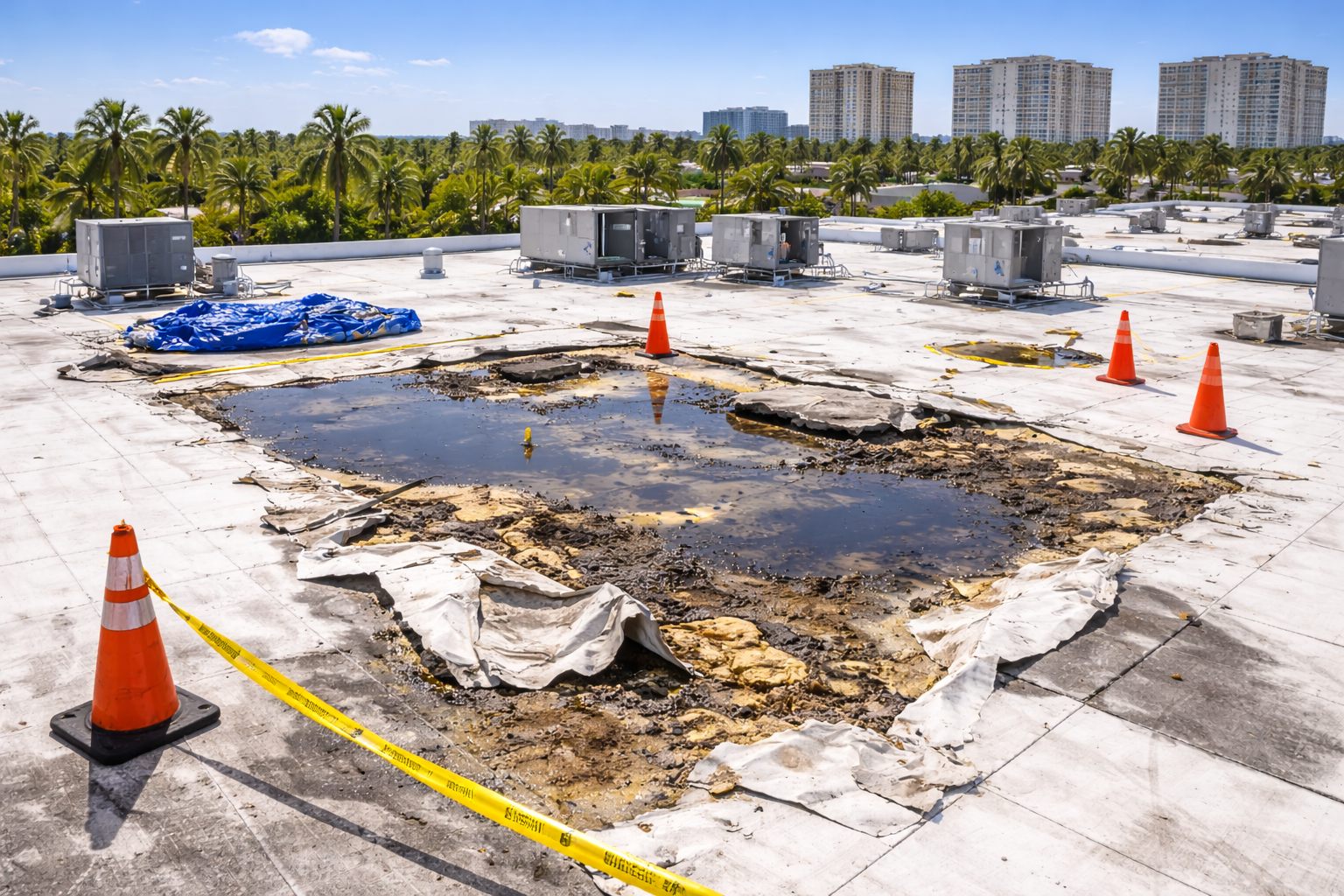
A flat or low-slope roof does not “shed” water the way steep roofs do. It depends on controlled flow. When that flow gets disrupted, water sits longer, stress increases, materials break down faster, and weak points start failing repeatedly.
The best managers build roof performance around drainage routines:
●
They check drains and scuppers before heavy rainy periods.
●
They watch for pondering patterns and don’t normalize them.
●
They track debris buildup after storms and address it fast.
●
They understand that drainage problems do not stay small.
This is one reason roof lifespan in Pembroke Pines varies so widely between properties. Two identical buildings can age differently simply because one treats drainage as a priority and the other treats it as an occasional cleanup.
Commercial leak complaints often start the same way.
A ceiling tile stains. A tenant notices dripping near a wall. Someone patches the area above where the water appears. It stops for a while. Then the next storm hits and the leak appears somewhere else.
Managers who extend roof life break that cycle early by insisting on one thing: the repair must target where water enters, not where it shows up inside.
Water travels. It can enter at a seam, migrate under the surface, and present far away. That is why symptom-based patching is one of the fastest ways to waste money on roofing.
Strong managers protect long-term roof performance by demanding repairs that focus on the roof’s critical connection points:
●
Seams
●
Flashing
●
Penetrations
●
Transitions
●
Parapet edges
●
Drainage zones
That approach does not just stop a leak. It prevents the roof from becoming a patchwork system that loses integrity over time.
There is a huge difference between “we do repairs” and “we maintain a roof.”
When repairs are inconsistent, roofs become complicated. Different materials are used across different years. Repairs are done by different crews with different methods. Over time, the roof becomes harder to diagnose and more likely to fail in unpredictable ways.
The best property managers avoid that by treating the roof as one system. They keep records. They standardize repair approaches. They track what was done, when, and why.
This creates continuity. Continuity makes roof problems easier to locate, easier to fix, and less likely to repeat.
That is commercial roof upkeep that actually reduces long-term cost.
Roofs do not fail randomly. They fail after stress.
In South Florida, stress periods are predictable:
●
Before storm season
●
After storm season
●
After major wind-driven rain events
Strong managers do not wait for tenant complaints to trigger action. They schedule roof checks based on when the roof is most likely to be tested.
This is not about being “extra careful.” It is about controlling timing.
When issues are identified early, repairs are smaller and disruption is minimal. When issues are identified late, repairs become urgent, approvals get rushed, and the property pays more in both dollars and downtime.
Roof work becomes expensive when it interrupts business.
Good managers build a habit of tying roof decisions back to operational impact. They ask:
●
How will this affect tenant access?
●
Are we protecting customer areas?
●
What spaces are most vulnerable if water intrudes again?
●
Are we planning work hours to reduce disruption?
This matters because roof stress is not just financial. It is reputational. Tenants remember disruptions. Businesses do not like uncertainty. Once complaints begin, they rarely stay contained.
Managers who extend roof life do not just “fix roofing.” They protect the building’s stability while roofing work is happening.
Every roof eventually reaches a point where repairs stop delivering value.
The smartest managers identify that moment early. Not because they want a replacement faster, but because they want control over timing.
A calm replacement decision looks like this:
●
Documented condition
●
Clear understanding of failure patterns
●
Scope planning that addresses root problems
●
Scheduling that minimizes tenant disruption
●
Budgeting that doesn’t hit all at once unexpectedly
A forced replacement decision looks like this:
●
Active leaks
●
Wet insulation
●
Interior damage
●
Tenant escalations
●
Rushed approvals
●
Higher costs due to urgency
Strong managers extend roof lifespan by avoiding forced decisions. They do that with documentation, routine checks, and targeted corrections that keep systems stable longer.
These patterns show up again and again in buildings that struggle with roofing:
Waiting for interior signs
By the time water is visible, it has often spread.
Treating ponding as normal
Standing water accelerates breakdown and hides damage.
Using incompatible repairs
Short-term fixes that don’t match the system can create new weak points.
Lack of documentation
When people change roles, the roof history disappears and problems repeat.
No inspection rhythm
Without scheduled evaluations, the roof becomes “unknown,” and unknown roofs are expensive.
Property managers who extend roof performance do not avoid problems because they are lucky. They avoid problems because they avoid these mistakes.
Well-managed properties tend to share the same outcomes:
●
Fewer emergency calls
●
Fewer repeated leak complaints
●
Smaller, more predictable repair scopes
●
Longer time before major replacement decisions
●
Cleaner budgeting and better stakeholder confidence
When managers treat the roof as a system and keep decisions evidence-based, the roof lasts longer and costs less to own.
That is the point. Not perfection. Reliability.
If your property keeps dealing with recurring leaks, surprise repairs, or roof decisions that feel unclear, the issue is usually not the building’s age. It is the lack of a roof management rhythm. C.A.R.E. Construction supports property managers with roof evaluations, targeted corrections, and maintenance planning that keeps roof performance predictable instead of storm-driven.
How often should a commercial roof be evaluated in a South Florida climate?
Most properties benefit from at least two scheduled evaluations per year, plus additional checks after major wind-driven rain events.
Why do leak stains appear in different places each time?
Because water can enter at one point and travel under the roof system before it shows up inside, especially on low-slope roofs.
What usually shortens commercial roof life the fastest?
Drainage issues, neglected seams and flashing, inconsistent repairs, and delayed evaluations that allow moisture to spread.
Is ponding water always a concern?
Yes. Persistent ponding increases heat stress, accelerates surface wear, and raises leak risk because water stays in contact with vulnerable details longer.
Can consistent maintenance reduce the chance of emergency leak calls?
Yes. Addressing early wear and drainage issues prevents small vulnerabilities from turning into active intrusion during storms.
What should a roof inspection deliver to a property manager?
Clear findings, photo documentation of vulnerable areas, and a recommendation that separates urgent issues from items that can be monitored.
When should a manager start planning for replacement rather than repeated repairs?
When failures become widespread, repairs no longer hold through weather cycles, or moisture issues keep returning despite proper corrections.
Why does documentation matter so much for roof decisions?
It speeds approvals, reduces disputes, supports budgeting, and prevents repeated mistakes when teams change or stakeholders ask for proof.
CGC1537535 | CCC1335982 | CMC1251555
At C.A.R.E. Construction, we uphold industry standards by using top-quality materials, cutting-edge tools, and delivering exceptional service to our clients.

2514 Hollywood Blvd STE 408
Hollywood, FL 33020

Broward:
Miami:
Tampa:
